


Jacksonville property taxes rising much faster than home values — Why does not it stop?
JACKSONVILLE, Fla. (DUANEWS) — November 3, 2026 — Homeowners in Jacksonville are facing a troubling financial trend: Property taxes have been increasing far faster than the value of their homes, according to a new…
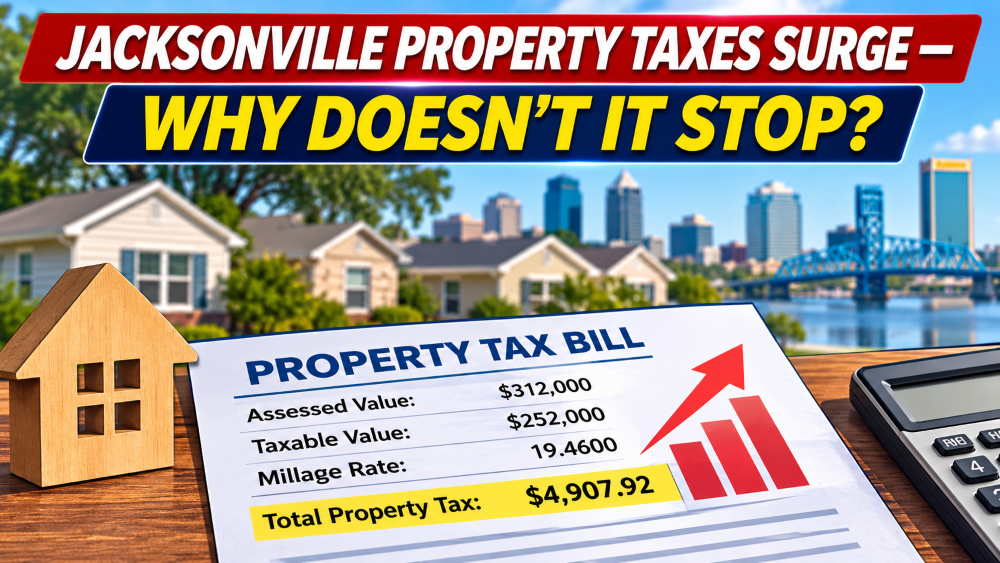
JACKSONVILLE, Fla. (DUANEWS) — November 3, 2026 — Homeowners in Jacksonville are facing a troubling financial trend: Property taxes have been increasing far faster than the value of their homes, according to a new national study.
The findings raise a question for thousands of Florida families already dealing with higher insurance premiums, utility bills and everyday living expenses: Why do property taxes keep rising, and what can be done to stop the increases?
Jacksonville Ranks Second in the Nation
A ConsumerAffairs analysis of U.S. Census Bureau data found that Jacksonville ranked second among the nation’s 100 largest metropolitan areas for the gap between property tax growth and home value appreciation.

Between 2022 and 2024:
- Property taxes increased 21.7%.
- Median home values increased just 8.1%.
- The difference was 13.6 percentage points.
The median annual property tax bill increased from approximately $2,307 in 2022 to $2,808 in 2024.
That represents an additional $501 per year for the median homeowner in the study.
Only Lakeland–Winter Haven, another Florida metropolitan area, recorded a larger gap between tax growth and home value appreciation.
Nationally, the trend was different. Home values increased 12.4%, while property taxes rose 10.6% during the same period.
Why Are Property Taxes Rising So Quickly?
Property taxes are calculated using a property’s taxable assessed value and the tax rates established by local taxing authorities.
In Jacksonville, those authorities include the city, school system and other applicable taxing districts.
One important factor is that property tax assessments and tax bills do not necessarily move in step with current housing prices.
Jacksonville experienced substantial increases in home values during 2021 and 2022. As mortgage rates rose and the housing market cooled, the pace of home value appreciation slowed.
However, taxable assessments, exemptions, changes in ownership and government budget decisions can continue to affect tax bills even when home prices are no longer increasing as quickly.
Florida’s Save Our Homes system limits annual increases in assessed value for qualifying homesteaded properties, but it does not guarantee that every homeowner’s total tax bill will remain unchanged.
Properties without homestead protection, recently purchased homes and properties subject to different exemptions can experience different tax outcomes.
Who Decides How Much Homeowners Pay?
The Duval County Property Appraiser determines property values and administers exemptions.
Local taxing authorities, including the Jacksonville City Council and other government bodies, establish property tax rates through their budget processes.
The Jacksonville Tax Collector then collects and distributes the taxes.
This distinction matters because rising assessments do not automatically require governments to maintain the same tax rates.
Local officials can consider adjusting millage rates as taxable property values change.
However, government budgets also fund services such as public safety, schools, roads and other local operations.
Whether to reduce taxes, increase spending or change the balance between them is ultimately a public policy decision.
Is There Any Way to Stop the Increases?
There is no single automatic mechanism that freezes property tax bills for every Florida homeowner.
Florida provides protections such as the Homestead Exemption and Save Our Homes assessment limitation for qualifying primary residences.
Homeowners can also review their property assessments, check whether they are receiving the exemptions for which they qualify and challenge inaccurate valuations through established procedures.
Local governments can influence tax bills by changing millage rates, while state lawmakers and voters can approve broader changes to property tax law.
But reducing property taxes also raises questions about how local governments would finance existing services.
Florida Voters Face a Major Property Tax Decision Today
The issue is especially timely because Florida voters are considering Amendment 3 in the November 3 general election.
The proposal would expand the homestead property tax exemption for qualifying primary residences, potentially reducing non-school property taxes for eligible homeowners.
Supporters argue that the change would provide relief to homeowners who have faced years of rising housing costs and property tax bills.
Opponents, including some local government and public safety representatives, warn that reducing the taxable property base could put pressure on budgets supporting essential services.
The measure requires approval from at least 60% of voters to become part of the Florida Constitution.
The outcome remains undecided as voters head to the polls Tuesday.
What About Homeowners Who Don’t Qualify for Homestead Exemptions?
Not every property owner would benefit equally from expanded homestead protections.
Rental properties, second homes, investment properties and some other non-homesteaded properties are treated differently under Florida’s tax system.
That distinction is important in Jacksonville, where the housing market includes homeowners, renters and real estate investors.
Changes that reduce taxes for one category of property may also influence future budget decisions affecting other property owners.
A Longer-Term Look Shows a Different Picture
Although the 2022–2024 numbers are striking, the ConsumerAffairs study also found that the relationship looks different over a longer period.
Between 2019 and 2024, Jacksonville-area home values increased 63.1%, while property taxes rose 44.9%.
That means home values actually grew faster than property taxes over the full five-year period.
The distinction does not erase the financial pressure homeowners experienced during 2022–2024, but it shows why the study should not be interpreted as proof that taxes have always increased faster than property values.
What Jacksonville Homeowners Can Do Now
Residents concerned about their property tax bills should review their latest assessment and confirm that their exemptions are correctly applied.
The Duval County Property Appraiser provides property records, assessment information and exemption applications through its official website.
Homeowners can also examine the millage rates charged by the different taxing authorities and follow local budget hearings.
The Jacksonville Tax Collector says property taxes are billed annually in November, with discounts available for early payment.
For residents paying directly, November payments qualify for a 4% discount under the county’s published payment schedule.
The Bigger Question for Jacksonville
The ConsumerAffairs findings highlight a growing concern about housing affordability in Northeast Florida.
A homeowner’s property may appreciate only modestly while the costs of maintaining it — including insurance, repairs and property taxes — continue to increase.
For families living on fixed incomes or managing tight household budgets, even a few hundred dollars in additional annual costs can make a difference.
The debate now centers on how to balance affordable homeownership with the revenue needed to operate local government.
DUANEWS — Your News. Your Voice.
Conversation 0