


Why is Jacksonville worried? Homeowners waited decades for major Homestead Relief as home prices soared
ERVIN SHKULAKU-JACKSONVILLE, FL — November 9, 2026 — Florida homeowners have spent years watching property values, insurance premiums, and household expenses climb. Now, after voters approved a major expansion of the Homestead Exemption, Jacksonville…
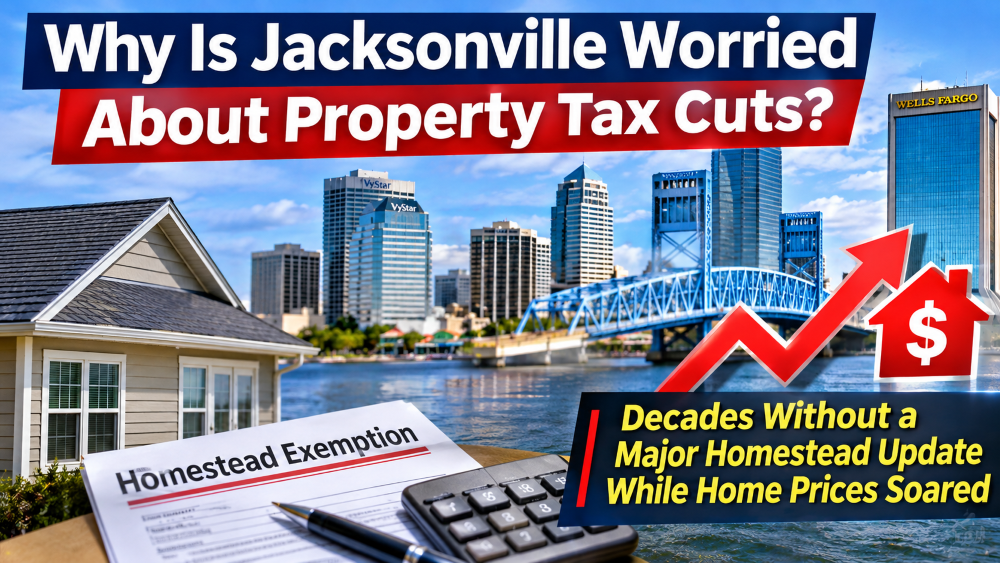
ERVIN SHKULAKU-JACKSONVILLE, FL — November 9, 2026 — Florida homeowners have spent years watching property values, insurance premiums, and household expenses climb. Now, after voters approved a major expansion of the Homestead Exemption, Jacksonville officials are warning that the tax relief could force significant reductions in city spending.
The debate raises an important question: Why is Jacksonville facing a budget crisis when homeowners are finally receiving substantial property tax relief?
The answer lies in the city’s dependence on property tax revenue, the rising cost of government services, and a tax exemption system that did not keep pace with housing prices for decades.

The Homestead Exemption: A Tax Break With Roots in 1980
Florida’s original $25,000 Homestead Exemption dates back to 1980, when the state increased the exemption from $5,000.
For decades, that basic amount remained unchanged, even as housing prices increased dramatically.
In 2008, Florida added another $25,000 exemption for qualifying property values above $50,000, excluding school district taxes.
Voters approved another change in 2024, allowing the additional exemption to increase with inflation beginning in 2025.
However, the original $25,000 exemption remained fixed.
That distinction matters because a $25,000 reduction in taxable property value provides much less relative protection on an expensive home than it did decades ago.
For example, $25,000 represents 25% of a $100,000 home’s value, but only 6.25% of a $400,000 home’s value.
Those percentages illustrate the declining relative size of the exemption, not the homeowner’s actual tax savings.
Florida’s Save Our Homes program also limits annual increases in assessed values for qualifying homesteaded properties, providing a separate protection against rapidly rising assessments.
Still, homeowners have faced increasing insurance costs, maintenance expenses, and other financial pressures.
What Florida Voters Approved in November 2026
On November 3, Florida voters approved Amendment 3 with approximately 62% support.
In Duval County, 56.5% of voters supported the measure.
The amendment significantly expands the Homestead Exemption for property taxes other than school taxes:
- 2027: Up to $150,000 in assessed value exempt from non-school property taxes.
- 2028: Up to $250,000 in assessed value exempt from non-school property taxes.
- After 2028: The expanded exemption will be adjusted for inflation.
The measure also reduces the annual assessment increase cap for non-homestead properties from 10% to 5%.
For a qualifying Jacksonville homeowner with a median-valued homesteaded single-family property of approximately $290,000, Duval County Property Appraiser Joyce Morgan estimated potential savings of $1,632 in 2027 and $2,674 in 2028.
Actual savings will vary depending on assessed value, applicable exemptions, and local tax rates.
Why Jacksonville Says It Could Lose $300 Million
Jacksonville depends heavily on property taxes to finance public services.
According to City Council estimates, Amendment 3 could reduce city property tax revenue by approximately $200 million in the 2027–28 fiscal year, with the annual reduction reaching roughly $300 million by 2028–29.
The city operates a general fund of approximately $2 billion, supporting police, fire protection, libraries, parks, public works, and community programs.
City officials argue that a major reduction in property tax revenue cannot be absorbed without changes to spending.
Mayor Donna Deegan has said the city will respect the voters’ decision and prepare a balanced budget.
Her administration has emphasized that public safety and essential neighborhood services remain priorities.
Libraries, Parks, and Children’s Programs Could Face Pressure
Jacksonville officials have indicated that police and fire services are not being targeted for direct budget cuts.
That leaves a smaller portion of the budget available for potential reductions.
Programs that could face pressure include recreational services, libraries, community initiatives, and nonprofit organizations receiving city funding.
One major concern is the Kids Hope Alliance, which supports after-school activities, tutoring, youth athletics, and other programs serving Jacksonville families.
The agency distributes funding to nearly 90 nonprofit organizations.
Council member Jimmy Peluso has warned about the potential loss of funding for programs serving children.
Nonprofit leaders have also expressed concern that reduced city funding could force organizations to serve fewer residents.
However, no final list of cuts has been approved.
Some Council Members Say Government Spending Should Be Examined First
Not everyone at City Hall agrees on how Jacksonville should respond.
Council member Rory Diamond has argued that financial incentives for downtown developers should be among the first spending priorities reconsidered.
He has also suggested reducing budgets associated with vacant city positions.
Other council members have raised concerns about broad hiring freezes and their possible effects on essential services.
The debate reflects two different approaches.
Supporters of tighter spending argue that local government should reduce administrative costs, reassess development incentives, and improve efficiency before reducing neighborhood services.
Officials concerned about the revenue loss argue that cuts of this magnitude could affect programs residents rely on, even after spending reviews.
Both sides now face the challenge of responding to a clear decision by Florida voters.
Did Property Tax Revenue Rise While Homeowners Struggled?
The relationship between rising home prices and city revenue is another important part of the debate.
According to a Jacksonville Daily Record analysis, Jacksonville’s property tax revenue increased by approximately 47% between fiscal years 2019 and 2027 after adjusting for inflation, while the city’s population grew approximately 9.5%.
Those figures have become part of the argument over whether government spending expanded too quickly.
However, increased revenue does not automatically mean the city has an equivalent amount of money available to cut. Government expenses, employee compensation, infrastructure needs, and service demands have also changed.
There is also an important distinction between market value and taxable value.
Under Florida’s Save Our Homes program, qualifying homeowners generally receive protection limiting annual assessed-value increases to 3% or the inflation rate, whichever is lower.
That means a home’s market value can rise sharply without its taxable assessed value increasing at the same rate.
Newly purchased properties may face a different tax situation when assessed values are reset following a sale.
What Happens Next in Jacksonville?
Jacksonville City Council is scheduled to meet on Tuesday, November 10, when the financial consequences of Amendment 3 are expected to remain a major topic.
Mayor Deegan’s administration is expected to present a revised, balanced budget in July 2027 for the fiscal year beginning in October.
Until then, discussions about libraries, parks, nonprofit funding, and other city programs remain proposals and concerns rather than finalized cuts.
Conversation 0