


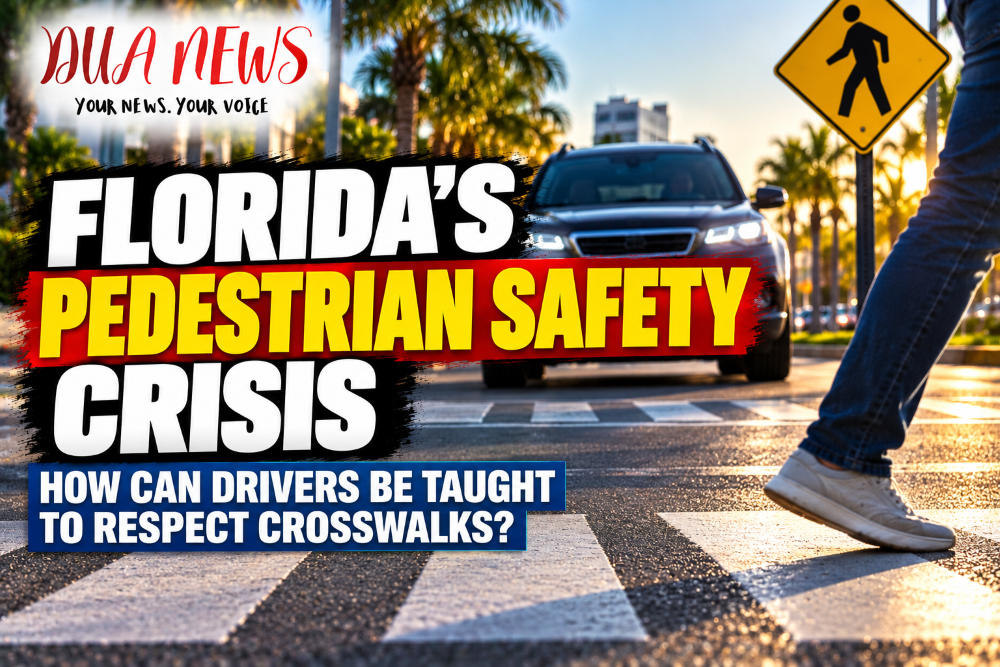
Florida’s pedestrian safety crisis: How can drivers be taught to respect crosswalks?
ERVIN SHKULAKU—JACKSONVILLE, Fla. — October 25, 2026. A 39-year-old pedestrian died after being struck by two vehicles while attempting to cross Philips Highway near The Avenues Mall in Jacksonville on Friday evening, October 23.…
ERVIN SHKULAKU—JACKSONVILLE, Fla. — October 25, 2026.
A 39-year-old pedestrian died after being struck by two vehicles while attempting to cross Philips Highway near The Avenues Mall in Jacksonville on Friday evening, October 23.
According to the Florida Highway Patrol, the man was attempting to cross the roadway near Southside Boulevard at approximately 8 p.m. when he was struck by a Honda CR-V and then a Ford Explorer.

He was transported to Memorial Hospital, where he was pronounced dead.
The circumstances surrounding the collision remain under investigation. Authorities have not established that either driver violated crosswalk laws.
But the tragedy raises a much broader question for Jacksonville and communities throughout Florida: What more can be done to protect pedestrians, and how can drivers be taught to respect crosswalks?
A Jacksonville Tragedy Highlights a Statewide Problem
The fatal collision is another reminder of the dangers pedestrians face on Florida’s busy roads.
Across the state, people walking to work, shopping centers, schools and public transportation must frequently navigate wide roads, heavy traffic and intersections where vehicles travel at high speeds.
While not every pedestrian crash occurs at a marked crosswalk, each serious incident highlights the importance of safer driving behavior and better roadway design.
Florida has spent years promoting pedestrian safety, yet preventable collisions remain a significant public safety concern.
The issue is not simply whether drivers know the rules. It is whether they consistently follow them.
Crosswalks Are Not Optional
Florida law establishes responsibilities for motorists approaching pedestrian crossings.
Under Florida Statute 316.130, drivers must stop for pedestrians in certain signal-controlled or properly signed crosswalks. At other crossings, motorists must yield as required by law, slowing or stopping when necessary.
The law also prohibits drivers from passing another vehicle stopped at a crosswalk to allow a pedestrian to cross.
These requirements exist because a pedestrian has little protection against a moving vehicle.
A moment of distraction, an impatient turn or a failure to look for someone crossing can have devastating consequences.
Education Must Begin Before Drivers Receive Their Licenses
One way to improve pedestrian safety is to place greater emphasis on crosswalk awareness in driver education.
New drivers should learn to anticipate pedestrians near shopping centers, schools, bus stops and residential neighborhoods.
Driving tests could devote more attention to yielding, safe turning and recognizing pedestrians at intersections.
But education should not stop once someone receives a driver’s license.
Public awareness campaigns, refresher courses and community outreach could remind experienced motorists that crosswalk laws are not optional.
Drivers should also understand that a green traffic light does not automatically mean they can turn without checking for pedestrians.
Can Stronger Enforcement Change Driver Behavior?
Education alone may not be enough.
Florida already operates pedestrian and bicycle safety initiatives that combine public education with targeted traffic enforcement.
In October, Tampa police announced a pedestrian and bicycle safety initiative scheduled to continue through May 2027.
Programs like these can help identify dangerous driving behavior and reinforce the importance of yielding to pedestrians.
Jacksonville and other Florida communities could benefit from consistent enforcement at locations where crash data identifies significant risks.
Warnings and citations may encourage compliance, but enforcement should ultimately be measured by whether it prevents injuries and saves lives.
Florida’s Roads Must Become Safer for Walking
Driver behavior is only part of the solution.
Many Florida roads were designed primarily to move vehicles efficiently, leaving pedestrians to navigate long crossings, wide intersections and fast-moving traffic.
Faded crosswalk markings, poor lighting and limited pedestrian signals can make already dangerous situations worse.
Local governments should consider more visible crossings, improved street lighting, pedestrian-activated signals, traffic-calming measures and safer intersection designs.
These improvements are particularly important near shopping centers, schools and public transportation stops.
The Jacksonville tragedy also raises questions about how pedestrians can safely cross major commercial corridors such as Philips Highway.
Pedestrians Have Responsibilities, Too
Pedestrian safety requires attention from everyone using the road.
People walking should obey traffic signals, use designated crossings where required and avoid entering the path of a vehicle that cannot reasonably stop.
Visibility is especially important after dark.
However, the responsibility carried by drivers is substantial because vehicles can cause severe or fatal injuries even at relatively modest speeds.
Motorists must remain alert and recognize that pedestrians are among the most vulnerable people on the road.
A Change in Driving Culture Could Save Lives
Florida’s Alert Today, Alive Tomorrow campaign promotes safer behavior through education, enforcement and improvements to transportation infrastructure.
But lasting change requires more than slogans.
Drivers should instinctively slow down near pedestrian crossings, look carefully before turning and prepare to stop whenever someone is crossing legally.
Respecting a crosswalk should become as routine as wearing a seat belt.
The death of a 39-year-old man in Jacksonville is a tragedy for his family and community. It should also encourage a wider discussion about preventing future pedestrian deaths.
Florida does not need to wait for another fatal crash to strengthen driver education, enforce existing laws and improve dangerous roads.
The white lines painted across a street are not decorations. They represent a place where human safety must take priority over speed and convenience.
The question facing Florida is whether drivers, lawmakers and local communities are prepared to make that principle a daily reality.
DUANEWS — Your News. Your Voice.
Conversation 0