

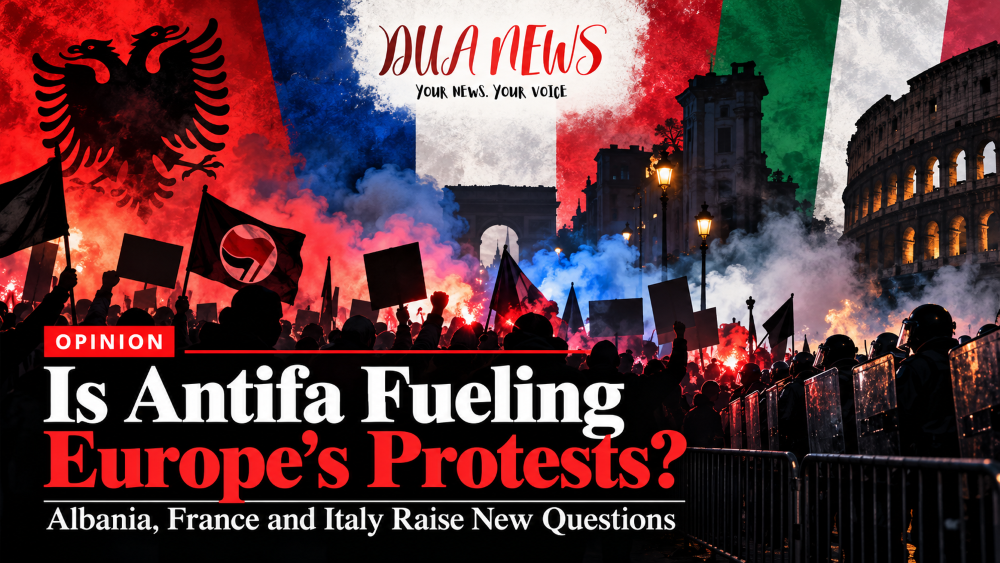
From Albania to France and Italy: Is Antifa weakening the West as China grows stronger?
DUANEWS Analysis | October 25, 2026 FLORIDA By Ervin Shkulaku As protests expose deep political divisions across Europe, the role of radical antifascist movements raises questions extending beyond domestic politics. Could Western instability create…
DUANEWS Analysis | October 25, 2026 FLORIDA
By Ervin Shkulaku
As protests expose deep political divisions across Europe, the role of radical antifascist movements raises questions extending beyond domestic politics. Could Western instability create strategic opportunities for China, even without Beijing directly influencing the unrest?

Europe is once again confronting the consequences of deep political and ideological divisions.
Recent demonstrations in Albania, France, and Italy have brought different political grievances into the streets. Some protests have remained peaceful, while others have involved confrontations with law enforcement.
The circumstances vary considerably from country to country, but one politically charged name has emerged in the debate: Antifa.
The term, short for antifascist, describes a decentralized collection of groups and activists opposing fascism and far-right extremism. Some advocate peaceful political action, while others embrace revolutionary, anarchist, or militant approaches.
As governments increasingly confront political radicalization, a larger geopolitical question deserves attention:
Could domestic divisions and militant political activism weaken Western democracies in ways that indirectly benefit China?
Albania: Rama raises allegations about Antifa and foreign influence
In Albania, recent antigovernment demonstrations have reflected public frustration over political accountability, corruption, education, and governance.
Some protests have escalated into confrontations with police, raising concerns about public security.
On October 24, Prime Minister Edi Rama accused violent protesters of attempting to destabilize Albania.
According to Albania’s public broadcaster RTSH, Rama alleged that organized crime and foreign actors were behind violent elements of the demonstrations.
He also referred to ideologically radicalized individuals, including Antifa supporters and religious extremists.
However, these allegations should not be confused with established findings.
Publicly available reporting has not demonstrated that an organized Antifa network is directing the Albanian protests or that foreign governments are coordinating the unrest.
The distinction matters.
Political violence should be investigated and prosecuted when evidence supports criminal charges. But legitimate public grievances must not automatically be dismissed because some demonstrators engage in violence.
Still, the Albanian situation raises a broader concern: Can radical groups exploit legitimate public dissatisfaction to intensify political instability?
France: Antifascist groups mobilize against the far right
France offers a different example.
On October 24, thousands of demonstrators gathered in Orléans to oppose a congress of the right-wing National Rally party.
The demonstration brought together left-wing political parties, labor unions, and antifascist organizations.
According to Le Monde, organizers estimated attendance at approximately 26,000 people, while authorities reported about 13,000.
Despite significant security restrictions and fears of confrontation, the main march proceeded peacefully.
A smaller gathering of approximately 150 activists subsequently called for more direct action.
The event demonstrates that antifascist organizations can play a visible role in European political mobilization.
However, the peaceful character of the main demonstration also illustrates why it would be inaccurate to equate antifascist activism automatically with violence or terrorism.
The political significance lies in the intensity of France’s ideological divisions and the growing difficulty of maintaining dialogue between opposing political movements.
When political disagreements become entrenched, even peaceful demonstrations can reveal deeper tensions within a democracy.
Italy: Radical left-wing activism and confrontations in Turin
Italy experienced a more confrontational episode on October 24.
In Turin, demonstrators participated in a protest against rearmament organized by Askatasuna, a movement associated with radical left-wing activism.
According to Rai News, Turin police estimated that approximately 4,000 people participated.
Police reported repeated attempts by protesters to move through security barriers.
Authorities subsequently announced two arrests, 25 criminal complaints, and 38 people taken to police offices during the operation.
These events highlight concerns about militant activism and confrontations between protesters and law enforcement.
But another distinction is essential.
Askatasuna should not automatically be identified with the Italian Informal Anarchist Federation/International Revolutionary Front, which the United States has formally designated as a foreign terrorist organization.
They are different entities, and organizational connections must be established through evidence rather than political similarities.
The protests in Turin demonstrate the presence of radical left-wing activism, but they do not establish that an international Antifa command structure is directing events across Europe.
Washington’s new approach to Antifa
The United States has significantly intensified its official scrutiny of Antifa-associated militancy.
On September 22, 2025, President Donald Trump signed an executive order designating Antifa a domestic terrorist organization.
The order directed federal agencies to investigate and disrupt illegal activities associated with the movement.
However, its legal implications remain debated because American law does not establish a general domestic terrorist organization designation system equivalent to the framework used for foreign organizations.
In November 2025, the State Department formally designated four militant European organizations as foreign terrorist organizations.
These included Germany’s Antifa Ost, Italy’s Informal Anarchist Federation/International Revolutionary Front, and two organizations based in Greece.
Those designations carry specific legal consequences.
They do not establish that all antifascist activists, or all organizations describing themselves as antifascist, belong to designated terrorist groups.
Nevertheless, Washington’s actions reflect concern about political violence and militant networks.
Could China benefit from Western political instability?
This is where the discussion becomes particularly relevant to international security.
China and the United States are engaged in long-term strategic competition involving technology, trade, military capabilities, and global influence.
A politically divided America may struggle to develop consistent long-term strategies.
A fragmented Europe may find it more difficult to coordinate policies on defense, economic security, and relations with Beijing.
From this perspective, prolonged political instability could create strategic opportunities for China.
Importantly, Beijing would not necessarily need to create or control political movements to benefit from the consequences of existing divisions.
The US Department of Defense’s 2025 report on China’s military and security developments described Chinese influence activities designed to promote anti-American narratives and weaken transatlantic relationships.
Such activities demonstrate that Western political divisions can become targets of foreign influence efforts.
However, there is a crucial limitation to this argument.
There is no credible publicly verified evidence establishing that the Chinese government directs or finances the broader Antifa movement as part of a coordinated effort to destabilize the United States and Europe.
A potential strategic benefit does not establish responsibility.
Furthermore, China remains economically connected to Western markets. Severe economic disruption in Europe or the United States could also damage Chinese commercial interests.
The geopolitical consequences of instability are therefore neither automatic nor exclusively advantageous to Beijing.
The West’s internal divisions may be its greatest strategic vulnerability
The central issue extends beyond Antifa itself.
Western democracies must manage increasingly intense disagreements over immigration, economic policy, national identity, international conflicts, and the role of government.
Democratic protest is not a sign of national weakness by itself.
On the contrary, the ability to criticize governments, organize demonstrations, and demand political change is one of the defining strengths of democratic societies.
The danger emerges when political disagreements turn into systematic intimidation, violence, or efforts to destroy confidence in democratic institutions.
This danger can arise from extremist movements across the ideological spectrum.
The recent events in Albania, France, and Italy illustrate different dimensions of the challenge.
In Albania, the government has alleged involvement by radicalized individuals, including Antifa supporters, but an organized Antifa role has not been independently established.
In France, antifascist organizations participated in a major peaceful demonstration.
In Italy, a radical left-wing movement organized a protest that resulted in confrontations with police.
These cases should not be treated as identical, nor do they establish an internationally coordinated campaign.
Yet they invite a broader question about the resilience of Western institutions.
Could foreign competitors exploit internal political divisions without directly controlling the movements involved?
History and contemporary security assessments suggest that political polarization can create opportunities for external influence.
Recognizing that vulnerability does not require treating political opposition as an enemy.
It requires distinguishing democratic dissent from violence, political ideology from organized criminal activity, and speculation from verifiable evidence.
Conclusion: China does not need to control Antifa to benefit from Western divisions
America and Europe remain among the world’s most influential economic, political, and military powers.
But their strength depends on more than financial resources, technological innovation, or military capabilities.
It also depends on public trust, stable institutions, respect for democratic freedoms, and the ability to resolve political conflicts without violence.
The protests in Albania, France, and Italy reveal different forms of political tension.
Some involve documented radical activism. Others have generated allegations that require further investigation.
There is no established evidence that these demonstrations form part of a single internationally coordinated Antifa operation, nor that China is directing them.
But that does not make the broader geopolitical question irrelevant.
China does not need to control Antifa to benefit from certain forms of instability within Western societies. And the West does not need a foreign conspiracy to suffer the consequences of its own internal divisions.
Perhaps the most important challenge for Western democracies is not simply identifying their external competitors, but preserving democratic stability while confronting internal polarization and political violence.
Ultimately, the greatest advantage for a geopolitical rival may come not from the actions it takes, but from divisions its competitors fail to resolve.
The West may be harder to weaken from the outside than through conflicts emerging within its own societies.
This article represents the author’s opinion and geopolitical analysis. It does not assert an established operational relationship between Antifa and the Chinese government.
About the author: Ervin Shkulaku is a Jacksonville, Florida-based journalist and former photojournalist associated with DUANEWS, an independent digital news platform.
DUANEWS — Your News. Your Voice.
Conversation 0