


FAA nationwide shutdown: How Florida airports are affected and what travelers need to know
MIAMI, Fla. — November 13, 2026 — A nationwide flight ground stop ordered by the Federal Aviation Administration (FAA) on Friday afternoon has disrupted air travel across the United States, including major airports in…
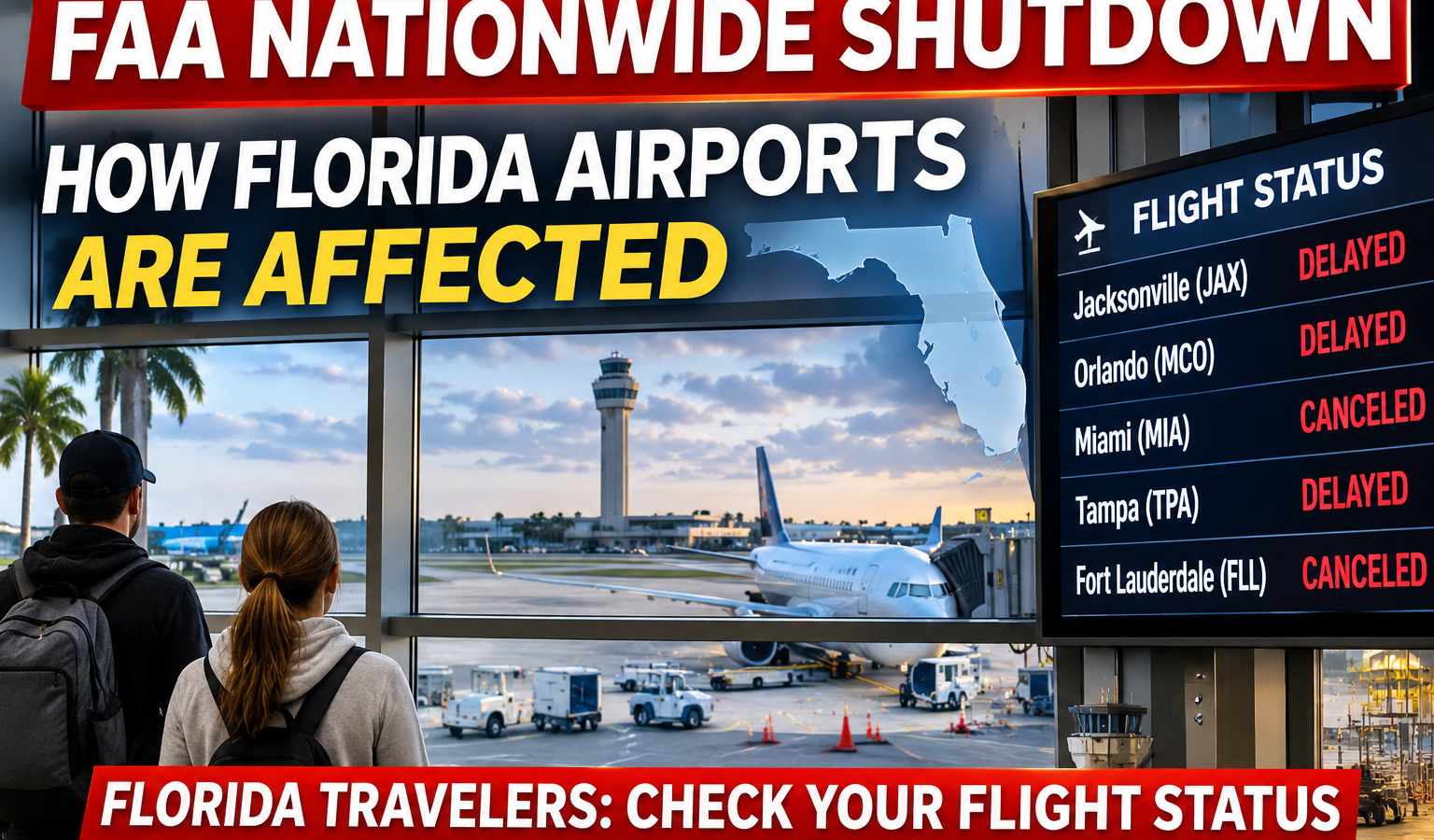
MIAMI, Fla. — November 13, 2026 — A nationwide flight ground stop ordered by the Federal Aviation Administration (FAA) on Friday afternoon has disrupted air travel across the United States, including major airports in Florida, leaving passengers facing delays, cancellations and uncertainty about when normal flight operations will resume.
The emergency order, issued at approximately 3:54 p.m. Eastern Time, followed a major telecommunications failure affecting the country’s air traffic control system.
The disruption has affected airports serving Jacksonville, Orlando, Tampa, Miami and other Florida communities, with potential consequences for domestic flights, international connections and weekend travel.

What Caused the Nationwide FAA Shutdown?
According to U.S. Transportation Secretary Sean Duffy, the FAA experienced communications problems affecting all 22 regional Air Route Traffic Control Centers responsible for directing aircraft traveling between airports.
These centers play a critical role in maintaining safe distances between aircraft and coordinating flights across the nation’s airspace.
The FAA ordered departing aircraft to remain on the ground as a precaution while technicians investigated the failure.
Federal officials have not confirmed the precise technical cause.
Homeland Security Secretary Markwayne Mullin said there was no indication that the disruption resulted from a deliberate attack, although the investigation remains ongoing.
Aircraft already in flight were generally permitted to continue to their destinations and land safely.
Florida Airports Affected by the Ground Stop
Because the FAA’s order applies nationwide, Florida’s major airports are subject to the same departure restrictions.
Orlando International Airport (MCO)
Orlando International Airport, one of the country’s busiest tourism gateways, faces potential disruption to flights carrying visitors to Walt Disney World, Universal Orlando Resort and other Central Florida destinations.
Passengers departing Orlando may experience delays or cancellations, while travelers arriving from other U.S. cities could face disruptions because their aircraft cannot depart from their original airports.
The situation could also affect connecting flights and travelers planning weekend vacations.
Miami International Airport (MIA)
Miami International Airport is a major gateway connecting the United States with Latin America, the Caribbean and Europe.
The airport has acknowledged the nationwide ground stop and advised passengers to check directly with their airlines before traveling to the airport.
The disruption affects domestic departures and could complicate international travel connections.
International flights arriving in the United States are being handled individually under FAA procedures.
Fort Lauderdale-Hollywood International Airport (FLL)
Fort Lauderdale-Hollywood International Airport is also affected by the nationwide restrictions.
The airport serves numerous domestic routes and international destinations, particularly throughout the Caribbean.
Travelers using low-cost airlines and passengers connecting through South Florida could face schedule changes.
Tampa International Airport (TPA)
Tampa International Airport is subject to the same nationwide departure restrictions.
Flights connecting Tampa with major hubs such as Atlanta, Charlotte, New York and Dallas may experience disruptions.
Even after the FAA authorizes departures to resume, delays could continue because aircraft and flight crews may be out of position.
Jacksonville International Airport (JAX)
Jacksonville International Airport is also covered by the FAA’s nationwide ground stop.
Passengers traveling from Jacksonville to major connecting airports could experience delays, cancellations or missed connections.
Because Jacksonville relies heavily on domestic connections, disruptions at larger airline hubs may continue to affect local passengers even after nationwide restrictions are lifted.
Travelers should confirm their flight status directly with their airline before leaving for the airport.
Thousands of Flights Delayed Across the United States
The nationwide shutdown has already caused extensive disruption.
According to FlightAware figures cited in national reporting, more than 9,000 U.S. flights had been delayed by approximately 5:19 p.m. Eastern Time.
These figures represent nationwide disruptions and do not indicate how many flights were delayed at individual Florida airports.
Airlines are also dealing with operational complications involving aircraft availability, flight crews, connecting passengers and airport congestion.
A nationwide ground stop can create a chain reaction that continues long after the original technical problem is resolved.
How Long Will the Shutdown Last?
The FAA initially issued the ground stop without a confirmed time for normal flight operations to resume.
Reports Friday evening indicated that the restrictions could remain in place until at least 11 p.m. Eastern Time.
However, that time should not be interpreted as a guaranteed reopening.
The FAA may adjust restrictions depending on the progress of repairs and safety assessments.
Travelers should monitor official announcements rather than assume flights will resume at a specific hour.
Could Florida’s Tourism Industry Be Affected?
Florida’s tourism industry depends heavily on reliable air transportation.
Orlando attracts millions of visitors to its theme parks, while Miami and Fort Lauderdale serve major international tourism and cruise markets.
Tampa and Jacksonville also depend on air connections for business travel, family visits and tourism.
If the disruption continues, travelers could miss hotel reservations, cruise departures, planned vacations and connecting flights.
Airlines and travel businesses may face additional logistical challenges as schedules are adjusted.
However, the financial impact on Florida’s tourism industry has not yet been determined.
What Should Florida Passengers Do?
Passengers with flights scheduled for Friday evening or Saturday should check their airline’s website or mobile application for the latest departure information.
Travelers should also verify connecting flights, monitor airport announcements and review available rebooking options.
If an airline cancels a flight and the passenger chooses not to travel or accept alternative transportation, federal refund rules generally require a refund for the unused ticket.
Additional compensation for meals, hotels or other expenses depends on the circumstances and the airline’s policies.
Passengers should retain receipts for unexpected travel expenses.
Is It Safe to Fly?
Federal officials have emphasized that the ground stop was ordered as a safety precaution.
The communications problem does not mean that aircraft already flying were automatically in danger.
Planes in the air were generally allowed to continue operating under applicable air traffic control procedures.
Authorities have not reported evidence that the outage resulted from a terrorist attack or deliberate cyberattack.
The FAA’s decision was intended to prevent additional aircraft from entering the system while the communications failure was investigated.
When Will Florida Flights Return to Normal?
Even after the FAA lifts the nationwide ground stop, Florida airports may continue experiencing delays.
Aircraft may need to be repositioned, flight crews may have exceeded permitted working hours, and passengers may need to be rebooked.
Airlines could require several hours or longer to restore normal operations, depending on how long the disruption lasts.
The extent of the recovery will depend on the duration of the outage and the number of flights affected.
For Florida travelers, the most important message is to verify flight status directly with their airline and continue monitoring FAA updates before heading to the airport.
Conversation 0