


Democrats are building momentum in the South — Could Florida be next?
DUANEWS ANALYSIS —With the 2026 midterm elections just weeks away, some of the Democratic Party’s most prominent national figures are spending increasing amounts of time in South Carolina — raising a bigger political question…
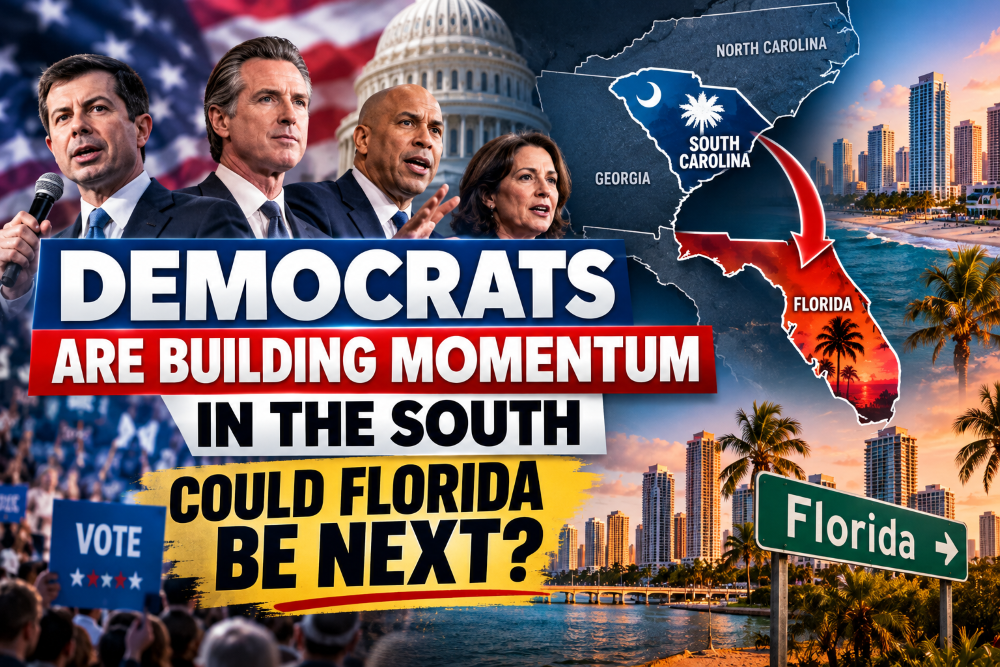
DUANEWS ANALYSIS —With the 2026 midterm elections just weeks away, some of the Democratic Party’s most prominent national figures are spending increasing amounts of time in South Carolina — raising a bigger political question for the Southeast: Is this simply preparation for 2028, or could Democrats eventually translate renewed organizing in the South into gains in states such as Florida?
South Carolina, located just north of Georgia and relatively close to Florida, has become particularly important for Democrats because it will open the party’s 2028 presidential nominating calendar. The Democratic National Committee has scheduled South Carolina to vote first on January 22, 2028.
In the coming weeks, several nationally known Democrats — including Ro Khanna, Andy Beshear, Mark Kelly, JB Pritzker and Rahm Emanuel — are scheduled to campaign in South Carolina. Pete Buttigieg, Gavin Newsom, Ruben Gallego, Cory Booker and Wes Moore have also recently visited the state. The Associated Press reports that these appearances are ostensibly about helping Democratic candidates in the 2026 midterms, while also giving potential 2028 presidential contenders opportunities to build relationships and test their appeal.

But does this mean Democrats are gaining ground in the South?
Not necessarily.
South Carolina itself remains politically dominated by Republicans, and the current Democratic activity there is closely connected to the state’s unusually important role in choosing the party’s next presidential nominee.
And Florida presents an even bigger challenge.
As of August 31, 2026, Florida had 5.65 million active registered Republicans compared with 4.10 million active registered Democrats — a Republican registration advantage of roughly 1.55 million voters. Another 3.33 million voters were registered with no party affiliation.
That represents a major change from 2020, when Florida had about 5.32 million registered Democrats and 5.22 million Republicans. In other words, the registration advantage has shifted substantially toward Republicans over the past six years.
Still, Florida is not politically uniform. Current state registration figures show Democrats continue to outnumber Republicans in Broward County, while Republicans now hold a registration advantage in Miami-Dade County.
So, could Florida become competitive again?
The political activity in South Carolina demonstrates that Democrats are investing attention in the South and beginning the groundwork for the 2028 presidential race unusually early. But it does not by itself demonstrate a Democratic resurgence in Florida.
Florida’s current voter-registration numbers point in the opposite direction statewide.
The bigger question heading toward 2028 is whether Democrats can reverse those trends — particularly among voters in Florida’s major metropolitan areas — or whether the Republican advantage built over recent election cycles will continue.
South Carolina may be where the Democratic battle for 2028 begins. But Florida could eventually become one of the states that tells us whether that strategy is actually working.
What do you think: Could Florida become a closely contested state again by 2028?
DUANEWS — Your News. Your Voice.
Conversation 0