


Florida’s new driver’s licenses are now available — what’s changing and what it means for immigrants
Ervin Shkulaku/DUANEWS Florida has begun issuing a redesigned driver’s license and identification card, with the new credentials becoming available at service centers across the state on September 30, 2026. The new cards have a…
Ervin Shkulaku/DUANEWS
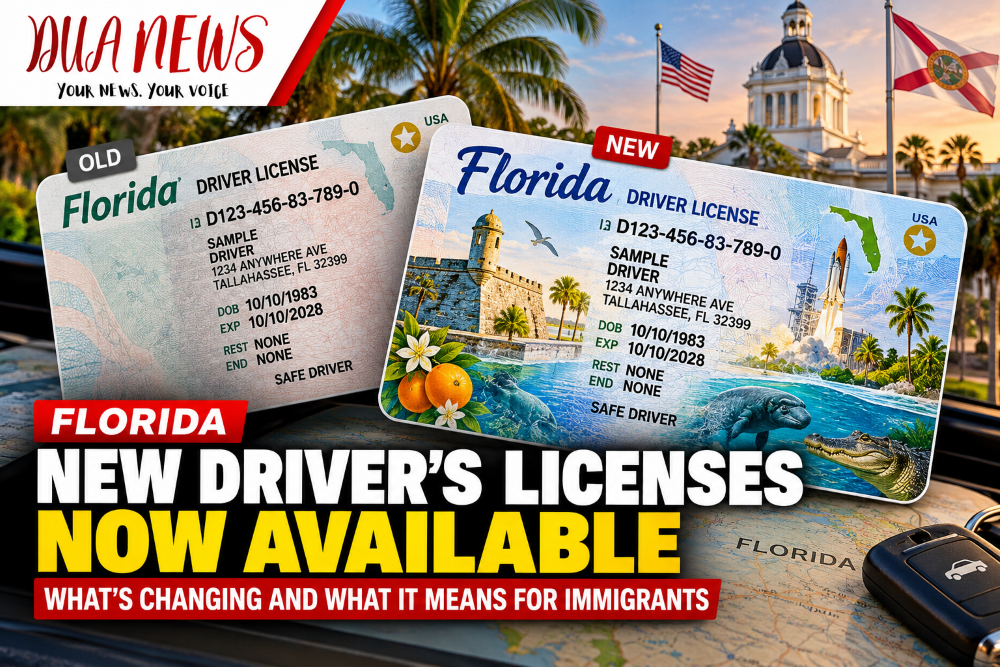
Florida has begun issuing a redesigned driver’s license and identification card, with the new credentials becoming available at service centers across the state on September 30, 2026.
The new cards have a completely updated Florida-themed design and additional security features intended to make the credentials more difficult to counterfeit.

The front features Castillo de San Marcos in St. Augustine, while a Florida orange, manatee and alligator are incorporated into the design. The back features Space Shuttle Discovery, highlighting Florida’s connection to the U.S. space program.
Do you need to replace your current license?
No.
Florida residents do not have to replace a valid driver’s license simply because the state has introduced the new design.
Existing licenses and identification cards remain valid until their expiration date. The old design will gradually disappear as residents renew or replace their credentials.
What about immigrants living in Florida?
This is where an important distinction needs to be made.
The new September 30, 2026 design does not put a general “immigrant,” “non-citizen” or immigration-status label on ordinary Florida driver’s licenses.
However, Florida law contains a separate provision concerning citizenship status.
Under Florida Statute §322.034, beginning July 1, 2027, a Florida driver’s license or identification card issued to a qualified applicant who is recorded in the state’s system as a U.S. citizen must include that person’s legal citizenship status when the credential is newly issued, renewed or replaced.
That means the upcoming change is specifically about U.S. citizenship status, not a general requirement to print someone’s immigration category on the card.
So, will a green-card holder have “immigrant” written on the license?
Not because of the new September 30, 2026 design.
A lawful permanent resident does not automatically receive a driver’s license with the word “immigrant” printed on it simply because they are a non-U.S. citizen.
Florida’s current law says the citizenship-status designation applies to applicants recorded as U.S. citizens.
There is also a separate category for certain commercial driver’s licenses (CDLs) and commercial learner’s permits (CLPs). Some qualifying commercial credentials can carry the designation “Temporary Non-Domiciled.” That is a specific commercial-license designation and should not be confused with a general immigration-status label on ordinary Class E driver’s licenses.
What if someone becomes a U.S. citizen?
Florida law says that when a license holder becomes a U.S. citizen, they must update their driver’s license or ID card within 30 days to reflect the change in citizenship status.
The law also provides that the department must issue a renewal or replacement license or ID without a fee when the person timely updates their legal status after becoming a citizen.
What should Florida immigrants do now?
For most immigrants who already have a valid Florida driver’s license, nothing needs to be done just because the new design has arrived.
If your license is still valid, you can continue using it until it expires.
When you eventually renew or replace it, you will receive the newer design if it is being issued at that time.
The important point is that having the new-looking Florida license does not itself mean that an immigration status will be printed on the front of the card.
The new design begins today. The separate citizenship-status requirement is scheduled for July 1, 2027.
Sources:
Florida Statutes — §322.034 Legal status designation
Florida Statutes — §322.19 Change of citizenship status
Conversation 0