


Florida’s amendment 3 deserves serious support
ERVIN SHKULAKU| DUANEWS Analysis | October 21, 2026 FLORIDA — For years, Florida homeowners have watched the cost of living climb. Housing prices, homeowners insurance, groceries, utilities and everyday expenses have placed increasing pressure…
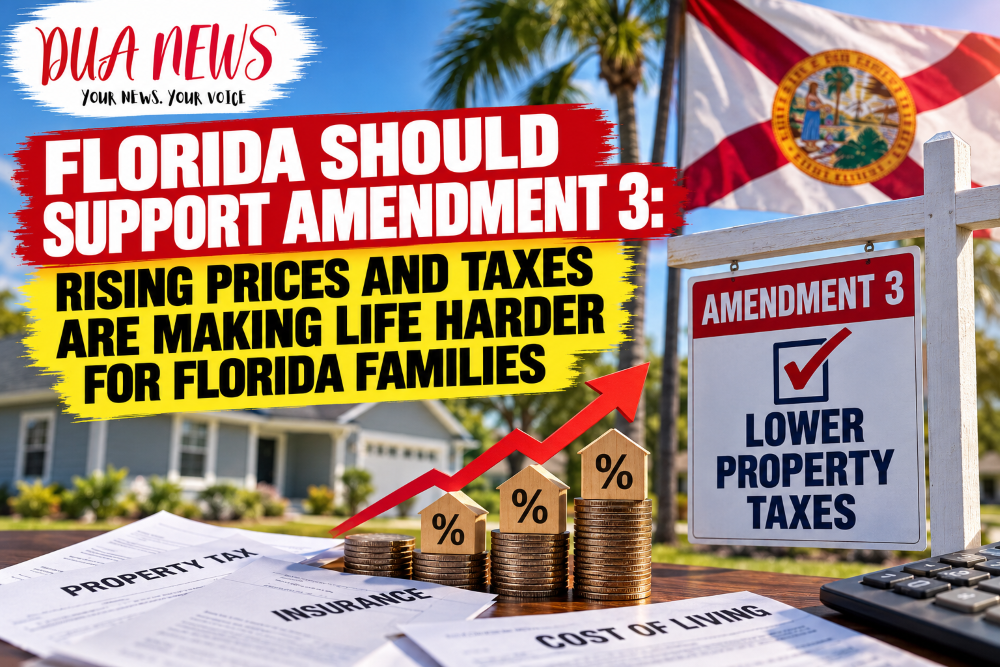
ERVIN SHKULAKU| DUANEWS Analysis | October 21, 2026
FLORIDA — For years, Florida homeowners have watched the cost of living climb. Housing prices, homeowners insurance, groceries, utilities and everyday expenses have placed increasing pressure on household budgets. Now, with the November 3 election approaching, voters face a consequential decision about property taxes.
Amendment 3 would significantly expand Florida’s homestead property tax exemption, potentially allowing many homeowners to keep more of their income at a time when affordability has become one of the state’s most pressing concerns.

A new University of North Florida poll suggests the proposal faces an uncertain future. But the debate should involve more than whether the amendment can secure enough votes. It should also address a fundamental question: Has Florida’s property tax system kept pace with the financial realities facing homeowners?
A Tax Exemption That Has Struggled to Keep Pace
Florida’s homestead exemption has a long history, dating back to the 1930s, when the state adopted protections intended to help residents remain in their homes during difficult economic times.
The last major statewide expansion of the general homestead exemption came in 2008, when voters approved an additional $25,000 exemption, bringing the commonly cited total to $50,000 for eligible homeowners. The additional exemption applies only to certain portions of assessed property value and excludes school taxes.
In 2024, voters approved an inflation adjustment to the additional exemption, which began taking effect in 2025.
That adjustment was an important step, but it did not fundamentally redesign the exemption to reflect the substantial changes in housing costs over nearly two decades.
Since 2008, Florida’s housing market has experienced dramatic changes. Property values have increased in many communities, while homeowners have faced rising insurance premiums, maintenance expenses and other costs associated with owning a home.
For many families, homeownership no longer represents the same level of financial security it once did.
A homeowner may have purchased a property years ago, watched its market value increase and still struggle to pay monthly expenses. Rising home values do not automatically translate into additional disposable income.
This distinction deserves greater attention in Florida’s property tax debate.
What Would Amendment 3 Change?
Amendment 3 proposes increasing the homestead exemption for property taxes other than those levied for public schools.
Under the proposal, the exemption would increase to $150,000 in 2027 and $250,000 in 2028, with inflation adjustments thereafter.
The amendment would also reduce the annual assessment increase cap on certain non-homestead properties from 10% to 5%.
These changes could substantially reduce taxable property values for qualifying homeowners. However, the exact savings would depend on each property’s assessed value, applicable exemptions and local tax rates.
The proposal also contains different treatment for some newer Florida homeowners, meaning the full benefits would not necessarily become available to everyone immediately.
Importantly, the amendment would not eliminate all property taxes, and school-related property taxes would remain outside the expanded homestead exemption.
New UNF Poll Shows Amendment 3 Faces a Difficult Vote
A University of North Florida poll released Wednesday found that Amendment 3 has support from approximately 50% of likely voters, below the 60% required to amend Florida’s Constitution.
The survey included 1,471 respondents and was conducted between October 12 and October 19.
According to the findings, approximately 30% opposed the amendment, while 14% remained undecided.
The results suggest that supporters still face a significant challenge in convincing enough voters before Election Day.
Other recent surveys have also indicated that support may fall short of the constitutional threshold, particularly when respondents are presented with concerns about possible reductions in local government revenue.
These findings should not be dismissed. They demonstrate that voters are weighing competing priorities and that the proposal’s consequences require careful explanation.
The Cost-of-Living Crisis Must Also Be Part of the Debate
Polling on Amendment 3 should not be considered in isolation from the broader affordability challenges affecting Florida.
Surveys examining household finances, housing affordability, insurance costs and inflation are equally relevant to understanding why property tax relief has become such an important political issue.
A voter may express concern about the financial consequences of Amendment 3 while simultaneously struggling with higher mortgage payments, insurance bills or grocery expenses.
Those positions are not necessarily contradictory.
Floridians want reliable public services, but they also want the ability to afford their homes.
The state must confront both realities rather than treating them as competing concerns that cannot be addressed together.
Why Property Tax Relief Deserves Support
There is a strong argument that homeowners who have established their primary residences in Florida deserve greater protection from the cumulative effects of rising housing-related costs.
Property taxes are particularly challenging because they can increase financial pressure on households without any corresponding increase in wages or retirement income.
For working families, retirees and residents living on fixed incomes, even modest annual increases can make long-term financial planning more difficult.
Expanding the homestead exemption would recognize that a primary residence is not simply an investment. For most families, it is the place where they raise children, build their lives and hope to remain after retirement.
A tax system should acknowledge that difference.
Amendment 3 offers a substantial form of relief that could make homeownership more sustainable for many eligible residents.
That is a legitimate reason for voters to give the proposal serious consideration.
But What About Schools, Police and Fire Departments?
Opponents of Amendment 3 raise an important concern: local governments rely heavily on property taxes to finance essential public services.
Reducing taxable property values could mean less revenue for counties and municipalities, potentially affecting services such as public safety, infrastructure, parks and emergency response.
Although the expanded homestead exemption would not apply to school property taxes, other local government budgets could face significant adjustments.
Those concerns deserve serious examination rather than dismissal.
Supporters of property tax relief should explain how local governments can adapt without undermining essential services or shifting costs onto renters and other taxpayers.
Similarly, local officials should clearly demonstrate which services could be affected and whether alternative budget solutions are available.
Florida residents deserve detailed financial projections, not simply campaign slogans.
Florida Needs a Better Balance
The debate over Amendment 3 ultimately reflects a larger challenge facing Florida.
The state has experienced substantial population growth, economic development and rising property values. Yet many households continue to struggle with affordability.
Economic growth should improve residents’ quality of life, not leave longtime homeowners feeling increasingly unable to afford the communities where they have lived for years.
Property tax relief alone will not solve Florida’s housing affordability crisis. Insurance reform, housing supply, wages and local government spending also require attention.
Nevertheless, reducing the property tax burden on primary residences could represent an important part of a broader affordability strategy.
The Decision Belongs to Florida Voters
With Election Day approaching, Amendment 3 deserves a debate grounded in facts, historical context and the everyday financial experiences of Florida residents.
The UNF poll shows that passage is far from certain. But public opinion surveys capture voter preferences at a particular moment; they do not determine whether a policy is economically justified or whether its design can be improved.
Voters should examine both the potential savings for homeowners and the possible consequences for local services.
Florida has changed significantly since the major homestead exemption expansion of 2008. Its property tax policies deserve to be evaluated against today’s housing market and cost of living.
DUANEWS Editorial Analysis
Conversation 0