


Inside the first report on the deadly Amazon plane crash
The National Transportation Safety Board has released its first preliminary report into the deadly Amazon cargo plane crash at Miami International Airport, providing new details about the aircraft’s final approach, its high speed and…
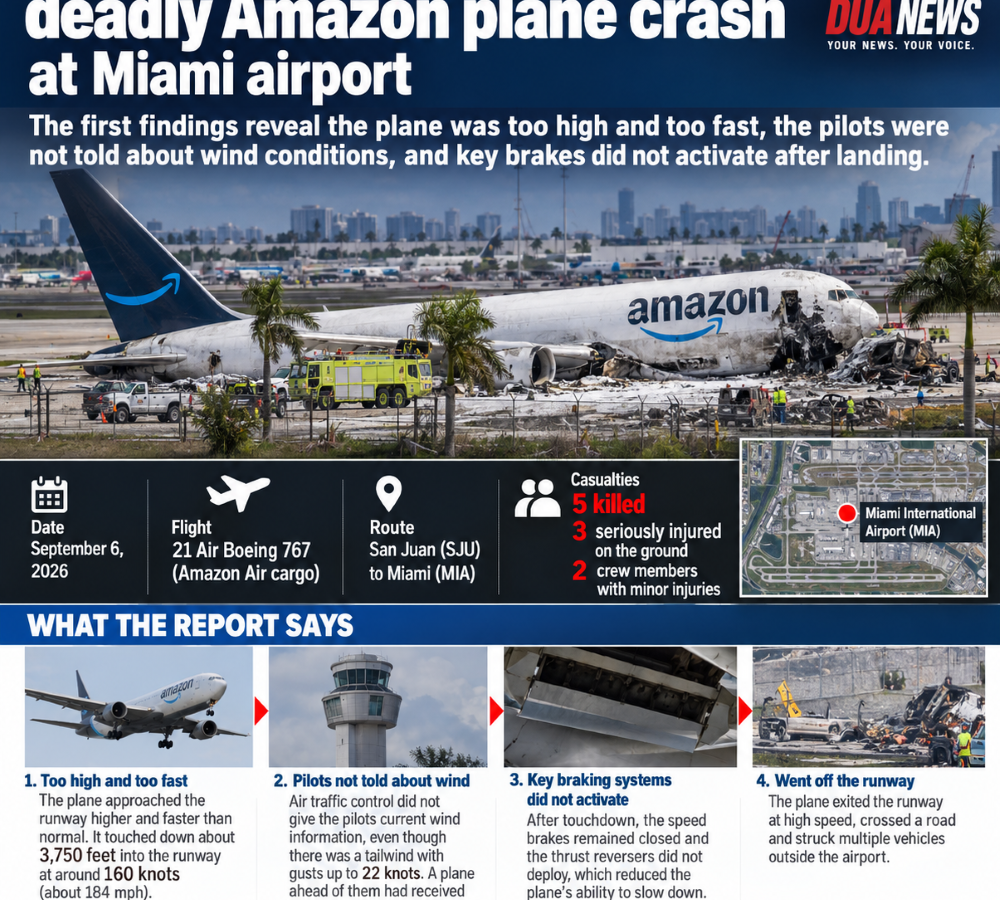
The National Transportation Safety Board has released its first preliminary report into the deadly Amazon cargo plane crash at Miami International Airport, providing new details about the aircraft’s final approach, its high speed and the moments before it ran off the runway.
The September 6 crash involved 21 Air Flight 7598, a Boeing 767 cargo aircraft operating on behalf of Amazon. The plane was arriving in Miami from San Juan, Puerto Rico, when it overran Runway 30 at approximately 1:53 p.m.
The aircraft continued beyond the airport perimeter and struck two vehicles on the ground.

Five people on the ground were killed and three others were seriously injured. Both pilots survived with minor injuries.
Plane came in too fast
Information recovered from the aircraft’s flight data and cockpit voice recorders shows that speed was already a concern during the final approach.
The first officer warned that the aircraft was traveling too fast and continued raising concerns about excessive speed as the Boeing 767 approached the runway.
The aircraft crossed the runway threshold at approximately 177 knots — about 204 mph.
It finally touched down approximately 3,750 feet beyond the beginning of the runway, traveling around 160 knots, or 184 mph.
That left significantly less runway available to bring the large cargo aircraft to a stop.
The cockpit also recorded multiple automated warnings during the approach, including alerts related to the aircraft’s descent and proximity to terrain.
Pilots were not given wind information
The preliminary investigation also identified another important detail.
According to the NTSB, the air traffic controller who cleared Flight 7598 to land did not provide the crew with current wind information.
Just minutes earlier, another aircraft had been given information showing strong winds and gusts in the area.
Federal procedures require wind direction and speed to be provided when a tailwind component exists.
Thunderstorms were also in the Miami area around the time of the accident.
Systems used to slow the plane did not deploy
Flight recorder data showed no indication that the aircraft’s speed brakes or thrust reversers were deployed.
Both systems can play an important role in helping a large aircraft slow down after landing.
The captain called for a go-around — an aborted landing followed by another attempt — after the aircraft had already touched down. By then, however, only about 415 feet of runway remained.
The Boeing 767 eventually left the runway, crossed the airport boundary and struck vehicles before coming to a stop roughly 1,200 feet beyond the end of the pavement.
A fire broke out around the aircraft’s right wing, and the plane sustained substantial damage.
Investigation continues
The NTSB stressed that this is a preliminary report, meaning investigators have not yet determined the official cause of the crash.
The investigation is examining several areas, including the actions of the flight crew, weather conditions, air traffic control communications, aircraft systems and airport operations.
The two pilots had flown together for the first time earlier that same day, according to the report.
Amazon later suspended its operations with 21 Air following the accident.
For now, the new report provides the clearest picture yet of the final minutes before the deadly crash — but the central question of exactly why the aircraft failed to stop safely remains under investigation.
DUANEWS — Your News. Your Voice
Conversation 0