


If Florida cuts property taxes, will insurance companies take a bigger bite?
By Ervin Shkulaku | DUANEWS.NET Florida homeowners could receive significant property-tax relief if voters approve Amendment 3 on November 3. But as residents look toward potentially lower tax bills, another question deserves attention: Will…
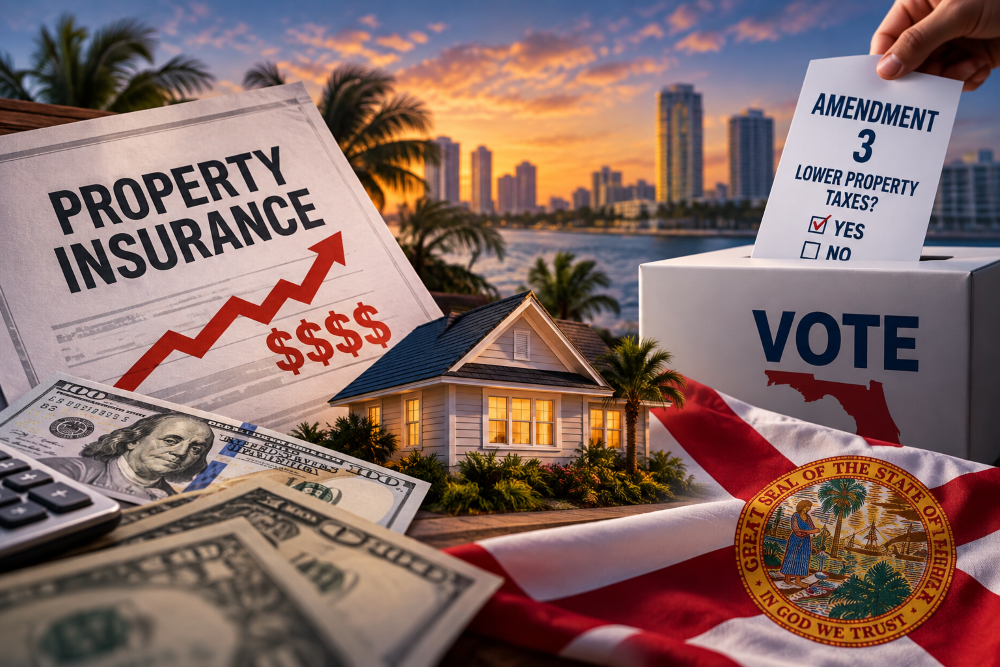
By Ervin Shkulaku | DUANEWS.NET
Florida homeowners could receive significant property-tax relief if voters approve Amendment 3 on November 3. But as residents look toward potentially lower tax bills, another question deserves attention: Will homeowners actually feel the savings if property-insurance premiums continue to rise?
Amendment 3 would substantially increase Florida’s homestead exemption for non-school property taxes. The exemption would rise from the current $50,000 to $150,000 in 2027 and $250,000 in 2028, while school property taxes would remain unaffected. The amendment needs at least 60% voter approval.

For many homeowners, that could mean meaningful tax relief.
But Florida has another affordability problem that may be even more important to homeowners: property insurance.
New poll sends a strong message
A new University of North Florida Public Opinion Research Lab survey of 1,511 insured Florida homeowners found that 63% were more concerned about property insurance than property taxes, compared with 36% who chose property taxes. The survey was conducted July 16–31 and had a margin of error of ±3.18 percentage points.
The numbers become even more striking when homeowners describe what has happened to their insurance bills.
According to the survey, 47% said their annual premium had increased by at least 50% during the past five years. Fifty-four percent reported changing their primary insurance company at least once during that period, and one-third had changed insurers at least twice
Only 18% said they believe Florida’s insurance market is improving and rates are likely to come down. Fifty-five percent said they see no signs of improvement, while another 26% believe the situation is getting worse.
Perhaps most revealing, when homeowners were asked who had benefited most from Florida’s insurance reforms, 69% answered the insurance industry, while only 16% said consumers had benefited most. That represents respondents’ perceptions, not proof that insurers have acted improperly, but it demonstrates the level of distrust surrounding the market.
Could tax savings simply disappear somewhere else?
This leads to a question Florida policymakers should be prepared to answer.
Suppose a homeowner eventually saves hundreds or even thousands of dollars through expanded property-tax exemptions. What happens if, during the same period, the homeowner’s insurance company increases the annual premium by a similar amount?
On paper, the homeowner received tax relief.
In the household budget, however, that relief could effectively disappear.
There is no evidence that Amendment 3 itself would cause insurance companies to raise premiums, and the two costs are determined through very different systems. It would therefore be wrong to suggest that passage of the amendment automatically gives insurers a reason or legal mechanism to take homeowners’ tax savings.
But Florida’s recent experience with insurance prices makes the broader question legitimate: How will the state make sure property-tax relief translates into improved housing affordability if insurance remains extraordinarily expensive?
Can Florida protect homeowners from unjustified increases?
Private insurance companies are businesses, and insurers must price policies according to risk, claims, reinsurance costs and other financial factors. Florida also regulates insurance rates through the state’s Office of Insurance Regulation.
That doesn’t eliminate the need for scrutiny.
If homeowners receive major tax relief while insurance premiums continue climbing, state regulators and lawmakers will face pressure to determine whether increases are supported by legitimate risk and cost data — and whether consumers are benefiting from the insurance reforms already enacted.
The question should not be whether Florida prevents insurers from making a profit.
The question should be whether Florida has sufficient oversight to distinguish financially justified rate increases from increases that cannot be adequately justified, while maintaining enough insurers in the market to give homeowners meaningful competition.
Florida’s affordability problem is bigger than one tax
The November vote will give Floridians a choice about property taxes. Supporters argue Amendment 3 would provide needed relief to homeowners, while critics warn that reducing local-government revenue could affect services or shift costs elsewhere. Estimates cited during the legislative debate projected billions of dollars in reduced non-school local-government revenue.
But the UNF survey highlights another reality: for many homeowners, property taxes aren’t their biggest housing concern.
Reducing one part of the cost of owning a home could certainly help families. But if another major expense continues rising, homeowners may find themselves asking a frustrating question a few years from now:
We saved money on property taxes — so why isn’t owning a home in Florida getting cheaper?
And that leaves an equally important question for Tallahassee:
If insurance premiums continue climbing after homeowners receive tax relief, will Florida be prepared to determine whether those increases are justified — and act when they are not?
Ervin Shkulaku is a reporter of DUANEWS, a Florida-based digital news platform. The views expressed in this article are the author’s own.
DUANEWS OPINION
Your News. Your Voice.
Conversation 0