


Panama’s powerful earthquake raises a bigger question
Ervin Shkulaku/DUANEWS.NET A powerful earthquake struck Panama on Friday, damaging buildings, forcing residents into the streets and triggering tsunami warnings across parts of Central and South America. The earthquake, reported at magnitude 7.7, was…
Ervin Shkulaku/DUANEWS.NET
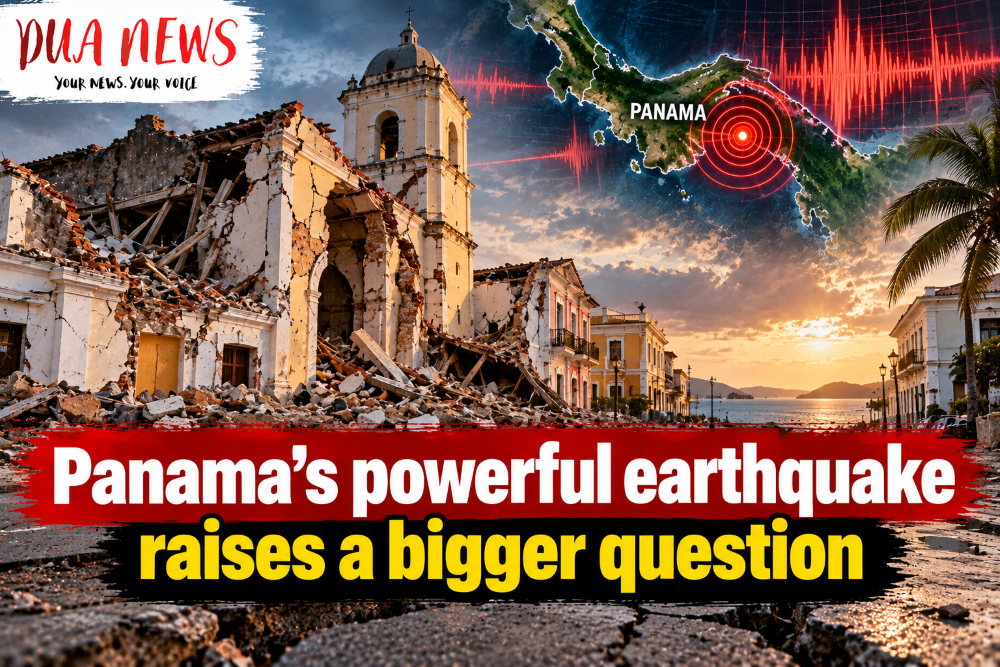
A powerful earthquake struck Panama on Friday, damaging buildings, forcing residents into the streets and triggering tsunami warnings across parts of Central and South America.
The earthquake, reported at magnitude 7.7, was followed by another strong tremor measuring 6.6 and dozens of aftershocks. Buildings were damaged near the epicenter, while the shaking was felt across much of the country.

But beyond the immediate destruction, the disaster raises a broader question: Are exceptionally powerful earthquakes becoming more frequent around the world?
The question is particularly relevant after several major earthquakes struck different countries during 2026, including the Philippines, Venezuela, Colombia and Indonesia.
Although earthquakes occur somewhere on Earth every day, those reaching magnitude 7.0 or higher are far less common.
And there is an enormous difference between a magnitude 7.0 earthquake and one measuring 7.8.
Why earthquake magnitude matters
Earthquake magnitude is measured on a logarithmic scale. Each increase of one full magnitude represents approximately 32 times more energy released.
That means a magnitude 7.8 earthquake releases nearly 16 times as much energy as a magnitude 7.0 earthquake.
A magnitude 8.0 earthquake releases approximately 32 times as much energy as a magnitude 7.0 event.
This distinction matters because simply counting earthquakes does not reveal the full picture of global seismic activity.
A year with fewer earthquakes could still release considerably more seismic energy if it includes one exceptionally powerful event.
How does 2026 compare with previous years?
An initial review of major earthquakes between April 10 and October 10, 2026, identified eight events reported at magnitude 7.0 or higher.
However, that preliminary count should not be treated as a final statistical assessment until the complete USGS earthquake catalog and revised magnitudes have been checked.
For comparison, USGS historical statistics show that 2015 recorded 19 earthquakes of magnitude 7.0 or greater worldwide, including one exceeding magnitude 8.0.
The year 2015 included a devastating magnitude 7.8 earthquake in Nepal and a magnitude 8.3 earthquake off the coast of Chile.
More recently, a magnitude 8.8 earthquake struck Russia’s Kamchatka Peninsula in July 2025, demonstrating how a single extraordinary event can dominate a year’s total seismic energy.
According to the USGS, the long-term average between 2015 and 2025 was approximately 13 earthquakes measuring magnitude 7.0–7.9 annually, along with fewer than one magnitude 8.0–8.9 earthquake per year.
These figures show that powerful earthquakes are relatively rare, but they are not unexpected on a global scale.
Why have so many countries experienced strong earthquakes?
Earthquakes occur when accumulated stress is suddenly released along faults in the Earth’s crust.
Many of the world’s most powerful earthquakes happen around the Pacific Ring of Fire, a vast zone of tectonic plate boundaries stretching around the Pacific Ocean.
Panama lies in a geologically complex region influenced by several interacting tectonic plates and fault systems.
According to Reuters, Panama’s geosciences officials linked Friday’s earthquake to accumulated stress in the Azuero-Soná fault system.
The earthquake struck at a relatively shallow depth, increasing the potential for damaging ground shaking near the epicenter.
USGS estimates indicated that tens of thousands of people experienced severe shaking, although early reports suggested Panama had avoided the widespread loss of life associated with some previous disasters.
Could these earthquakes be connected?
The occurrence of powerful earthquakes in several countries over a relatively short period can appear alarming.
However, earthquakes happening thousands of miles apart are not automatically connected.
Scientists recognize that one major earthquake can trigger aftershocks and, in certain circumstances, influence nearby faults.
But that does not mean every powerful earthquake around the world is part of a single global chain reaction.
There is currently no established scientific evidence that the recent earthquakes represent a worldwide acceleration of tectonic activity.
The USGS also emphasizes that scientists cannot reliably predict the exact time, location and magnitude of future major earthquakes.
Is the Earth becoming more dangerous?
The answer requires separating three different questions: how many major earthquakes occur, how powerful they are, and how much damage they cause.
The number of earthquakes alone cannot answer whether global seismic energy is increasing.
Likewise, the destruction caused by an earthquake depends on much more than its magnitude.
Depth, distance from populated areas, local geology, building quality and emergency preparedness all play critical roles.
A magnitude 7.0 earthquake beneath a densely populated city can cause more deaths and destruction than a much stronger earthquake in a remote region.
For a meaningful comparison, researchers would need to examine the complete global earthquake catalog over several decades, particularly the number of events above magnitude 7.5 and 8.0 and the total seismic energy released.
What Panama’s earthquake tells us
Friday’s disaster is another reminder of the immense forces operating beneath the Earth’s surface.
It also highlights how important earthquake-resistant construction, public warning systems and emergency preparedness remain.
The recent concentration of major earthquakes deserves careful scientific examination, especially when comparing their magnitudes and energy release.
But the available evidence does not establish that the planet has entered an unprecedented period of seismic activity.
The real question is not simply whether more earthquakes are happening. It is whether the world’s most powerful earthquakes are becoming more concentrated — and whether the data support that impression.
For now, science offers a clear distinction: powerful earthquakes are frightening, but a series of major events does not, by itself, prove that an even larger disaster is approaching.
Conversation 0